
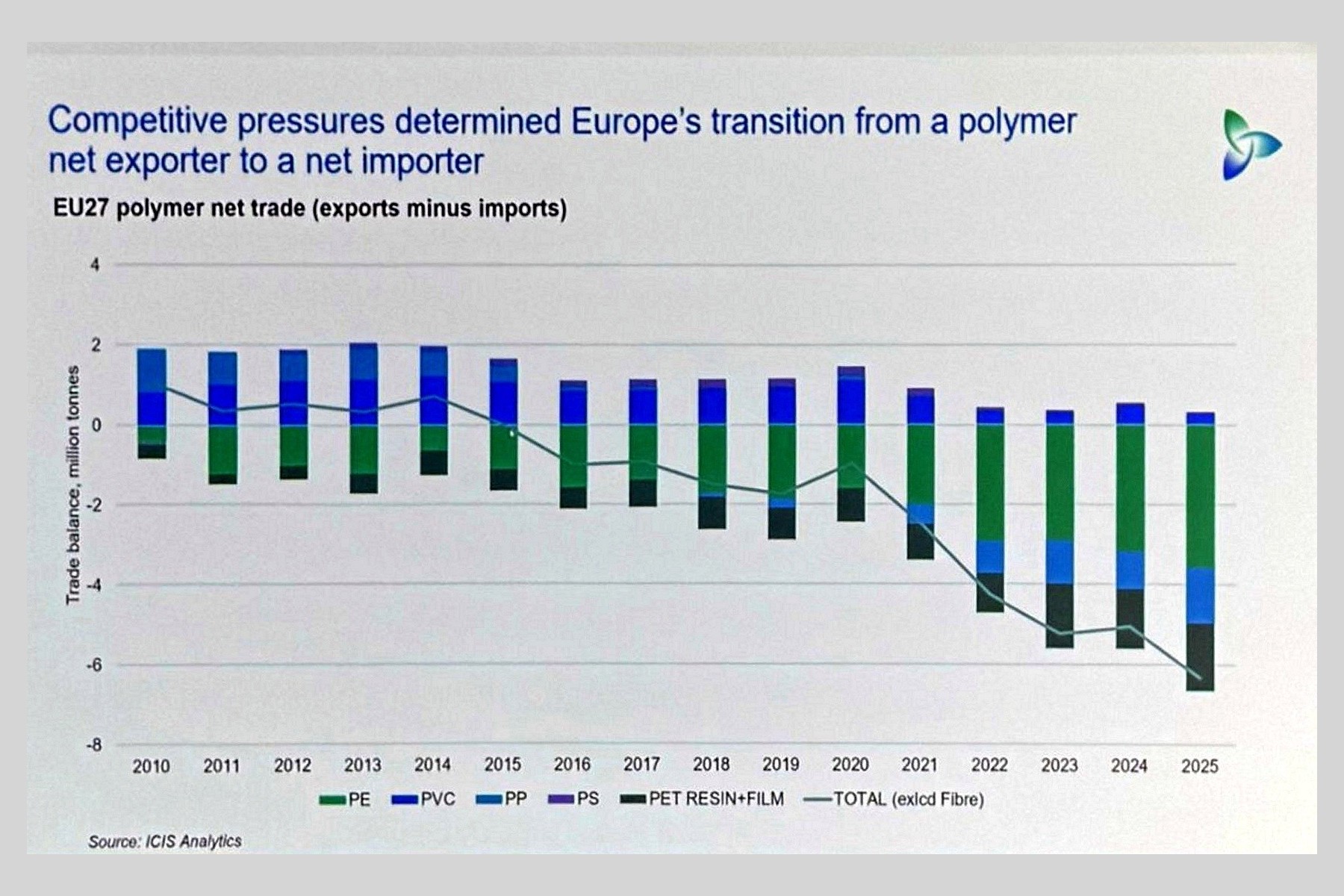
Europe now imports more plastic than it exports, and the plans to close the gap all focus on finding more material. At the Plastiwin plenary on 25 November 2026, Egor Dementev, EMEA analyst team lead at ICIS, described European polymer markets as facing a “perfect storm”. His data makes a strong case for asking a different question.
Key figures
- Since 2016 Europe has been a net importer of polymers, at around 6 million tonnes in 2025.
- $215 vs $800+ per tonne: production cost in the Middle East compared with Europe.
- 5 vs 3.6 million tonnes: recycled polymer needed for the PPWR 2030 targets, compared with what Europe produced in 2025.
- 27%: share of European PET demand already covered by recycled PET made in Europe.
Three facts from the ICIS analysis
1. Europe has lost its place as a plastics exporter
Until the mid-2010s, Europe sold more polymer abroad than it bought. Since 2016 the balance has reversed, and by 2025 Europe’s net imports had reached around 6 million tonnes (Figure 1, top of this article).
2. The cost gap is structural
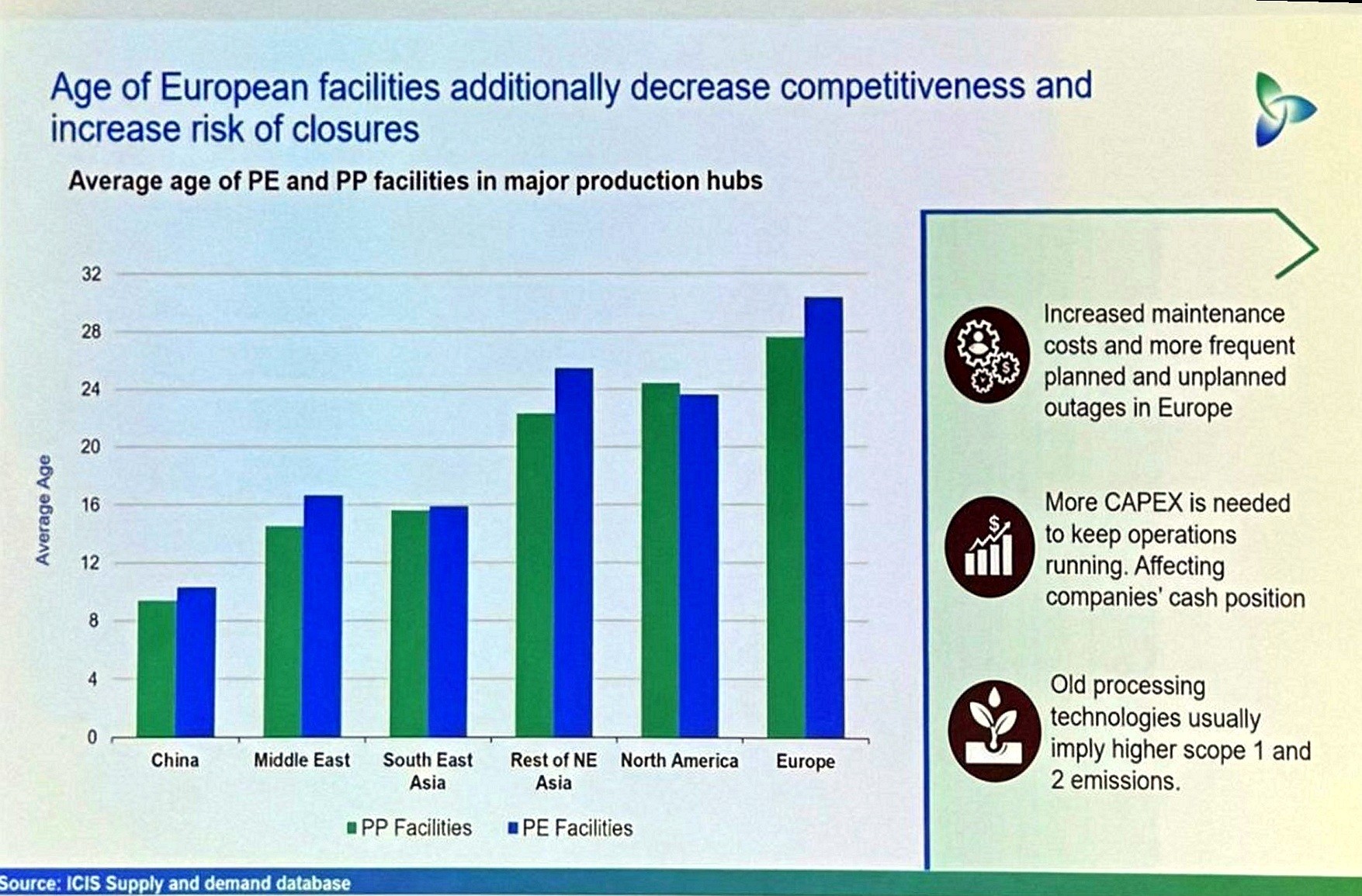
ICIS puts production costs at around $215 per tonne in the Middle East, against more than $800 in Europe. The energy crisis of 2022 made things worse, but years of under-investment and ageing plants were already there. Tariffs alone will not close a gap of that size.
3. Regulation is raising demand for recycled material faster than Europe can supply it
Meeting the 2030 targets of the Packaging and Packaging Waste Regulation (PPWR) will take around 5 million tonnes of recycled polymer. Europe produced about 3.6 million tonnes in 2025, most of it not good enough for packaging. PET is the exception: recycled PET made in Europe already equals about 27% of demand, and food-grade recycled PET has sold at a premium to virgin material since 2019.
Four options, one blind spot
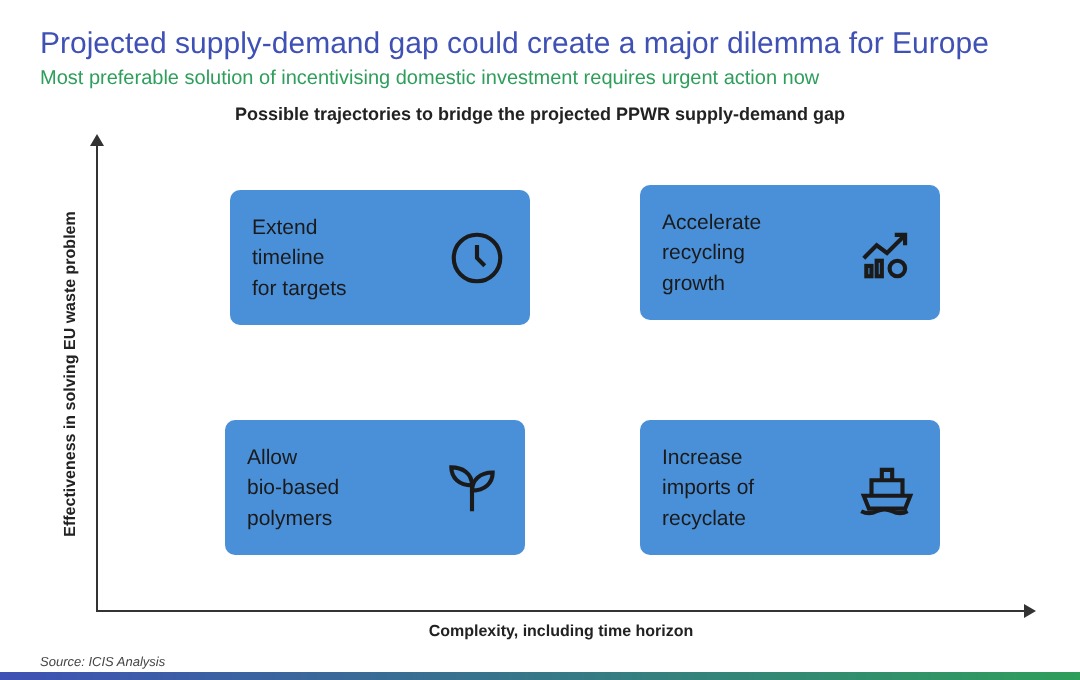
ICIS sees four ways to bridge the gap: extend the timeline for targets, accelerate recycling, allow bio-based polymers, or import more recyclate. Each is valid, and each costs time or adds complexity. But all four share one assumption: demand stays where it is and has to be fed with a different material.
There is a fifth option, and the PPWR itself lists it first: prevention. Use less material for the same product.
What we are working on
At Keiryo, we work on that fifth option: getting the same performance from less material, on the production lines that already exist. Two lines of work are under way.
Lightweighting PET
Our FENIC technology improves PET morphology during injection moulding, so each bottle does more with less material: lighter preforms with the same performance, or better barrier, strength and heat resistance. It works with both virgin and recycled resins.
Mixing recycled and virgin resin
We already have one technology running in industrial production. GateMix™ homogenises the melt right at each gate, so colourants and additives are spread evenly and quality improves, with fewer streaks, defects and rejects. We are now validating scientifically that this even melt also improves performance when recycled and virgin resin are mixed.
Neither replaces recycling. Both aim to make every kilo of plastic, recycled or virgin, go further.
Every kilo saved is a kilo Europe does not have to produce, import, collect or recycle.
When material is expensive, imported and increasingly regulated, using less of it is not a side topic. It may be the fastest lever Europe has.
Data and charts: ICIS, presented by Egor Dementev at the Plastiwin plenary, 25 November 2026. Thanks to Plastiwin for bringing the sector together, and to ICIS for sharing its analysis.
